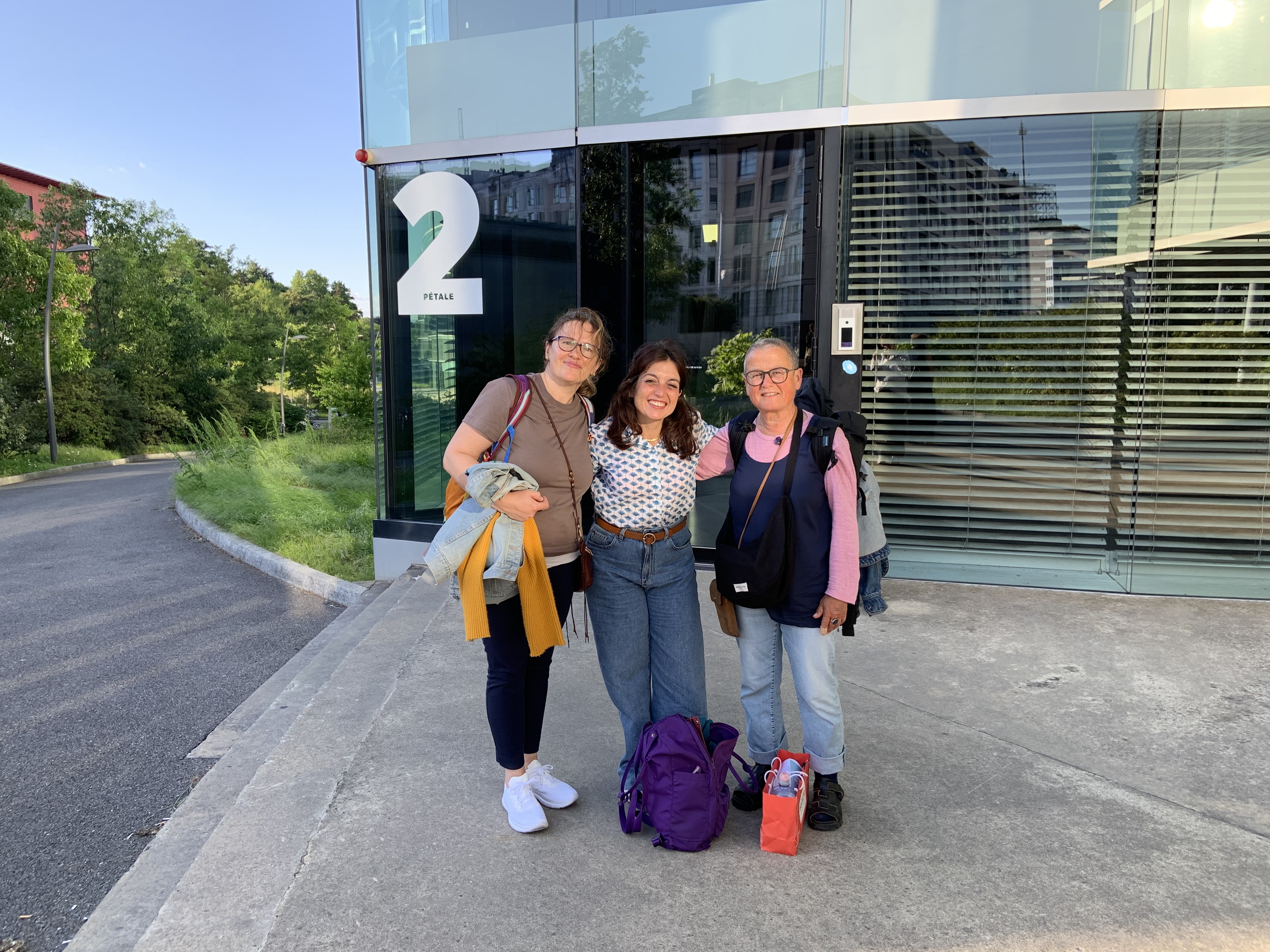
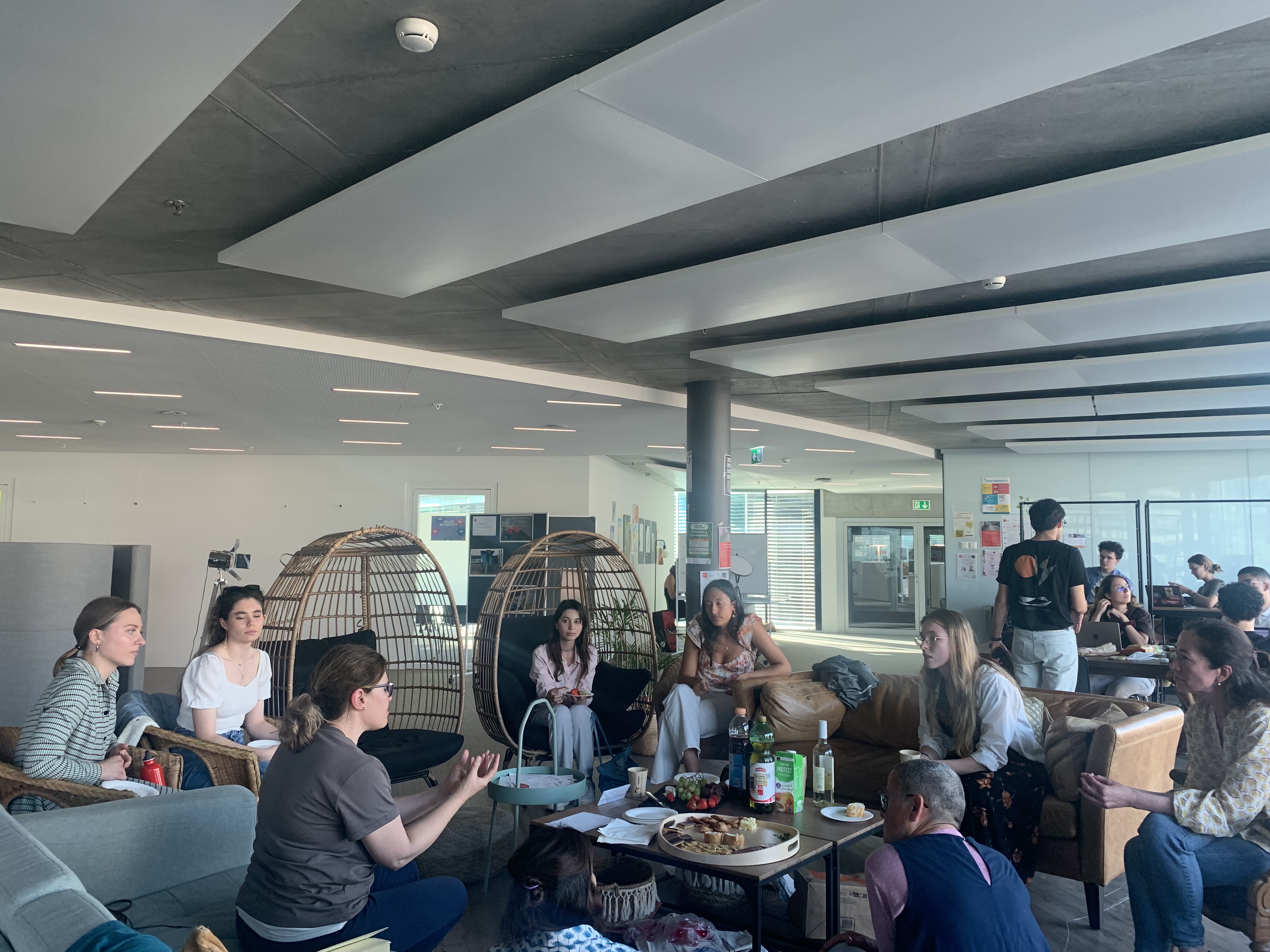
On May 15, 2025, in collaboration with “The Fab” and Peacebuilding Initiative, we (left to right on the photo below: Yuliya, Beatrice, and Magdalena) facilitated a discussion among Geneva Graduate Institute students on the theme of “Integration of International and Local Students in School.” Below are some of our reflections and learnings that we would like to share.
Co-existence of the local and international sides
We talked about the divide between Swiss Geneva and International Geneva, and how language could be one of its aspects. However, we also shared that speaking French might not necessarily close this gap. There is also a class issue and economic difference in it, and geographic position plays a role. For example, on one side of the lake, there is the old city, and on the other side, there are the offices of international organizations. Placing oneself in the old parts of the city may be one of the ways to get more in touch with the local people as an international student. However, it requires more effort (daily travelling to work/study, emotional involvement), and sometimes being in the own bubble may be good and important too.
There was a shared sense that being in the own bubble is not necessarily bad. Especially once in a while, if not always. At the same time, as it turns out, it is not completely possible to be isolated: the same split or dichotomy of “local vs. international” can be found inside one community or a human being. As we continued our conversation, the participants in the room shared both their “international” and “local” sides (sometimes beautiful and sometimes heavy). We had stories from Canada, India, the Netherlands, Italy, Sweden, America, Ukraine, and Switzerland. We talked about how these two sides, or even universes, international and local ones, can co-exist, and some of us saw the richness of this co-existence in each participant.
Systems thinking and thinking beyond systems
In the interaction about the divide between the local and the international groups in Geneva, one Swiss participant explained how it is important to have more systemic and at the same time more precise view, as Switzerland is not monochromic as it may be seen from an outer view; it have its inner diversity, with more mainstream German-speaking parts and more marginal sides that speak French, Italian, and Romansh. That brought a new perspective and adjusted the “lenses” on how to look at the hosting/receiving country, moving away from a general view, and having more precision, interest, understanding of the majority-minority dynamic, and opening up to complexity and diversity here.
Labelling vs. interest in a human story
Labelling was one of the themes of our discussion. We shared how easy it was to put people into categories and label the other. We also mentioned how Switzerland was not only about cheese and chocolate, or how Italy was not just about Ferrari. Or how one student from Ukraine was not just a usual person, but how she carried various stories and experiences, both beautiful and heavy. One participant said that it was tiring to be constantly associated with the country of origin, because a human being was greater than one’s social role or nationality.
We talked about how sometimes the international community contributed to the divide by this stereotypical mindset, and how it was important to notice and be aware of the own tendency to label the other. One of the learnings was instead of asking “Where are you from?” ask “What is your story?”—to be curious and be able to meet the other person with all her/his richness and diversity. Curiosity to understand the other in all diversity was on the other side of labelling, to allow connection, personal enrichment, and learning.
Learning is caring
At one moment there was a viewpoint of a receiving country who welcomed international people, migrants, refugees and travellers, and expressed sadness for people coming and going due to many reasons (war, better life, ecology to name a few), and not paying attention or not caring to meet the land and its people, or being unhappy at the place. There was a deep sadness and a wish for people who come to love and care for the land and its spirit.
In response to it, we talked about expectations from both sides, and how it is not bad to have some expectations from the foreigners, as there was a basic care behind. One student shared a story about how she studied in the Netherlands several years ago, and how she regrets that she did not learn Dutch at that time. That was a touching moment when some of the participants realized that we happened to live/study/work in certain places, and it may not last forever, but as long as we are in one place or another, there was a great chance to learn something new—a new language, a new culture, and it could be a way to connect, and to care.
Relationships as one of the most stable things in today’s world
We talked more about how international people and migrants contributed to the divide between local and international communities by coming and going, and admitting to being oftentimes disinterested in any long-term connections and relationships with the local people. Then one participant, also in a role of a war refugee, shared how she came for a short while with the intention to return back home quickly, and in the beginning did not pay attention to build any relationships, and how she changed this attitude as the war did not end soon, realizing that eventually relationships were the most stable thing in today’s world. One’s house can be burned, but relationships stay.
We look forward to more such conversations in the future. Stay tuned.
 livingtogether.world
Leave a comment